
A short story by Kisanna Szabó
Cherry Trees down Marigold Street
Part 1
Open the grey toggle and read the text. In the red toggle, you can see the same text with the grammar of this chapter highlighted, and the words explained – just hover your mouse over the word and you will see the definition.
Press ‘play’ in the blue box below to listen to the story. Listen to it with and without reading the text, too.
Listen to the story
Part One
He tried not to have any expectations. Nothing would look quite the same. Things would seem smaller, houses and gardens would have been changed – converted, extended, knocked down… He was trying not to have any expectations, but colourful memories of his childhood in Marigold Street kept surfacing in him and he couldn’t help feeling nostalgic. It felt good, but it was heavy, too. Like carrying a tired child.
He only had to cross the vacant lot at this end of the street and he’d be there. This strange, empty space was the size of a town square, and, as he remembered, there was nothing on it but dust, scrub, and a few flowers from the random seeds the wind had scattered there. The place didn’t even have a name, so they had just referred to it as ‘the vacant lot’. It was a place with neither function nor beauty, abandoned by both nature and man.
The vacant lot hadn’t changed much and he felt relieved by that. It still had that post-apocalyptic feel. It was almost as vacant as it used to be, except that a concrete pathway now ran through it. That particularly cold winter came into his mind when the snow hadn’t stopped falling for ten days straight. By the end, it was thigh-deep. No-one took care of the vacant lot back then, so the only way through it was through the thick layer of cold whiteness. An adventure in itself. But whether she was in the mood for an adventure or not, his mother had to work if they wanted to eat, so she would carry him on her shoulders to kindergarten every day, there and back. He loved these shoulder rides through the snow: they felt exciting and safe at the same time. His mum’s struggle through the cold white mass somehow gave him a feeling of protection, of being fought for.
When he turned into Marigold Street, he stopped walking without realizing it. He was looking at the street where he was born and had spent the first thirteen and a half years of his life. He hadn’t been back here since they’d moved, over fifteen years before.
Green bushes and trees lining the curving road: it was very much like it used to be. Except that of course it seemed shorter and narrower. And except for the concrete. And the cars. When he was a kid, they used to play in the middle of the road in the dirt, a soft, sandy dirt, very good to build things out of. It was a dead-end street at the very edge of town, and the only two people who had cars hardly ever used them. Even small children were allowed out on the street, and played there for hours without supervision. He thought of playgrounds these days: meticulously planned to be safe, with soft ground and fences around them, and parents hovering there, not trusting either their children or the people walking by…
He took a deep breath and went on walking. It was 6 o’clock in the evening and the sun was shining from behind him, pouring golden light over everything.
The first house on the left had been the home of Mr and Mrs Egbert. They were the Marigold Street sentinels: nothing missed their prying eyes; they saw everyone coming and everyone leaving. There had been only one break-in during the time he lived here, and who could have been the key witnesses if not the Egberts? Stealing a colour TV had counted as a major crime in those days (almost as bad as reporting your neighbour to the state security agency, just that the former was punished and the latter rewarded). He remembered passing the little group of police officers, the Egberts and some curious neighbours on his way home from school. Mr and Mrs Egbert were interrupting each other and everyone else, eager to convince the officers of their opinions.
‘The teacher’s brother is a lawyer, he surely wouldn’t do such a thing, nor would Annie, she’s only twelve, she wouldn’t even be able to carry that big box!‘
The officers leaned away from Mrs Egbert, she was speaking so loud.
‘- and the girl at the end of the street’s boyfriend is a decent guy, too, but that fourth person, that…‘ broke in Mr Egbert, in a more reserved but still very eager manner.
‘… That man… with that awful beard, what was he doing here, eh? He had no business here, I’m telling you.’
When one of the policemen mentioned that someone else might have been there under the cover of night, the Egberts were offended.
‘Oh no, no-one comes here at night. We would know. The dogs would bark and we’d know.’
It turned out later that their suspicions were right. And also, they always found the bunny. Well, almost always.
When he was five, he got a little black bunny for Easter. Not wanting to keep it in a cage, he and his mother made a home for it out of a cardboard box. The bunny seemed a defenceless creature with not much skill or sense of adventure, so the tall, solid wooden fence around the garden seemed an obstacle big enough to keep the precious bunny at home. However, it obviously wasn’t, as the bunny kept running away. The Egberts had somehow always found and returned it, and provided details on how it had tried to escape. The Egberts had eyes and ears everywhere. The rumour might have been true: there was a fair chance that they were spies.
One day, the bunny was gone and the Egberts knew nothing about it. If they had been spies, that day must have been the beginning of the end of their career. It was definitely the end of his unconditional liking for them, and from then on he could hardly bear to talk to the old couple. For years after its disappearance, he could not erase the idea from his head that the Egberts had captured, cooked and eaten his fluffy, glossy black bunny. He imagined other possible scenarios – his bunny losing against the tortoise in a race and then committing suicide out of shame, the bunny returning to its roots and living wild in the woods with other runaway rabbits – this one seemed the most plausible.
Now the Egberts’ house had been renovated. A floor had been added, and a terrace on the side, and the whole house had been painted a cheerful yellow. Too cheerful. There were kid’s bikes and a sandpit in the garden, but not a soul around.
The neighbouring parcel had always been empty. The house on it had been severely damaged in the revolution, and the family who lived there had emigrated. He must have been around four when the local council truck came and knocked it down. Its lovely, lush garden, however, kept on growing. It had a treasure in it: a magnificent, tall cherry tree with the biggest, darkest, juiciest and sweetest cherries on the face of the earth. So juicy that when they were ripe, their skin tended to burst open while they were still on the tree.
Now there was a house there with a very neatly arranged garden. Everything was rectangular, trimmed and regimented, and the tree was gone. Had these people no respect whatsoever? Why on earth had they chopped down the old cherry tree? How could someone possibly do a thing like that? He could hardly bear to see the empty space where the tree had been, the tree that he had loved so much that he used to call it his friend.
It was that late orange and golden summer afternoon sunlight that lends even the ugliest things a certain charm. This kind of light playing among the branches and the leaves of the cherry tree had been a part of the magic of his childhood summers. As was Nicki’s giggly laughter. They would spend whole afternoons up in that cherry tree, talking, reading, teasing each other, spying on the neighbours and the passers-by. They even used to play tag up there!
With its lush cherries, climbable and comfortable branches, the tree made up for the lack of a playground in the neighbourhood. Everyone in the street knew it and made use of it in one way or another: families put children there to play, sometimes cut off branches for poles and flowers, and then there was the marvellous fruit… The cherry tree was an institution.
One thing about big cherry trees with marvellous fruit is that they tease humans by growing their biggest, ripest cherries on the uppermost branches, out of reach. Those cherries smile temptingly and shine their dark, lusty ruby red down in the faces of cherry-loving humans.
One June afternoon, when he was eleven and Nicki ten, he decided that he’d finally get some of those hard-to-get treasures. He had to tiptoe along very thin and oddly spaced branches, hold on with his fingertips, balance and twist this way and that, but he succeeded. He got two handfuls of the divine fruit. However, as he was making his way triumphantly back down to the lower branch where Nicki was sitting, drunk with success, he was not cautious enough, and one of the branches cracked under him and his feet slipped. For an instant his blood froze, but he threw his body sideways, wrapped his arms around the trunk and steadied himself before Nicki’s scared shriek died away.
‘Are you all right?’
He didn’t say anything, just stepped closer to her and opened his hand to offer her the contents. In his palm, there was just a pile of dark red mush, with juice oozing out of it. The expression on Nicki’s face went from confusion to disappointment to gratitude and pride.
‘Thank you.’ she said and took a bit of the cherry mush and put it straight into her mouth. A dark red drop was rolling down her face and her hand was stained red. He found it lovely. He also put some in his mouth. They were looking into each other’s eyes, smiling and laughing at the red liquid all over their faces. Then Nicki kissed him on the lips. It happened so fast that the next day when he woke up he wasn’t sure if it had really happened. But when he met Nicki again, he knew that it had. He had been looking for that cherry-tasting kiss ever since.
As he walked he kept twisting his neck to look back at the empty space where the beloved cherry tree had been, trying in vain to picture the exact position of the particular branch that the kiss had happened on. Then he turned to look ahead. Keep going.
Diagonally across on the right was the house where Mike used to live. Mike. The darkest storm cloud in the clear blue sky of his childhood. Oh, how he had despised that kid! He was a nuisance and a menace, he wouldn’t stop harassing the other kids, and he especially enjoyed annoying him and Nicki. He would shoot pebbles at them out of his slingshot, steal their things, swear at them, grab Nicki and pull her hair. Now Nicki’s frustrated cries echoed in his head: ‘Tell him to knock it off!’ and he’d run to face the menace. ‘He’s being mean, do something,’ and he’d push Mike away. ‘Mike won’t stop bugging me!’ and he would go there and face Mike: ‘Pick on someone of your size, will you?’ Nicki took it for granted that he would come to her aid, but she was grateful, too. When Mike hit him and broke his nose, she insisted on going with him to the hospital. The next day, Nicki found Mike’s bike left out on the street. She snuck over there with a bunch of rotten eggs and smeared the seat and the handlebars with them. Later, she told him proudly of her revenge.
Part One - for learning
He tried not to have any expectations. Nothing would look quite the same. Things would seem smaller, houses and gardens would have been changed – converted, extended, knocked down… He was trying not to have any expectations, but colourful memories of his childhood in Marigold Street kept surfacing in him and he couldn't help feeling nostalgic. It felt good, but it was heavy, too. Like carrying a tired child.
He only had to cross the vacant lot at this end of the street and he’d be there. This strange, empty space was the size of a town square, and, as he remembered, there was nothing on it but dust, scrub, and a few flowers from the random seeds the wind had scattered there. The place didn’t even have a name, so they had just referred to it as ‘the vacant lot’. It was a place with neither function nor beauty, abandoned by both nature and man.
The vacant lot hadn’t changed much and he felt relieved by that. It still had that post-apocalyptic feel. It was almost as vacant as it used to be, except that a concrete pathway now ran through it. That particularly cold winter came into his mind when the snow hadn’t stopped falling for ten days straight. By the end, it was thigh-deep. No-one took care of the vacant lot back then, so the only way through it was through the thick layer of cold whiteness. An adventure in itself. But whether she was in the mood for an adventure or not, his mother had to work if they wanted to eat, so she would carry him on her shoulders to kindergarten every day, there and back. He loved these shoulder rides through the snow: they felt exciting and safe at the same time. His mum’s struggle through the cold white mass somehow gave him a feeling of protection, of being fought for.
When he turned into Marigold Street, he stopped walking without realizing it. He was looking at the street where he was born and had spent the first thirteen and a half years of his life. He hadn’t been back here since they’d moved, over fifteen years before.
Green bushes and trees lining the curving road: it was very much like it used to be. Except that of course it seemed shorter and narrower. And except for the concrete. And the cars. When he was a kid, they used to play in the middle of the road in the dirt, a soft, sandy dirt, very good to build things out of. It was a dead-end street at the very edge of town, and the only two people who had cars hardly ever used them. Even small children were allowed out on the street, and played there for hours without supervision. He thought of playgrounds these days: meticulously planned to be safe, with soft ground and fences around them, and parents hovering there, not trusting either their children or the people walking by…
He took a deep breath and went on walking. It was 6 o’clock in the evening and the sun was shining from behind him, pouring golden light over everything.
The first house on the left had been the home of Mr and Mrs Egbert. They were the Marigold Street sentinels: nothing missed their prying eyes; they saw everyone coming and everyone leaving. There had been only one break-in during the time he lived here, and who could have been the key witnesses if not the Egberts? Stealing a colour TV had counted as a major crime in those days (almost as bad as reporting your neighbour to the state security agency, just that the former was punished and the latter rewarded). He remembered passing the little group of police officers, the Egberts and some curious neighbours on his way home from school. Mr and Mrs Egbert were interrupting each other and everyone else, eager to convince the officers of their opinions.
‘The teacher’s brother is a lawyer, he surely wouldn’t do such a thing, nor would Annie, she’s only twelve, she wouldn’t even be able to carry that big box!‘
The officers leaned away from Mrs Egbert, she was speaking so loud.
‘- and the girl at the end of the street’s boyfriend is a decent guy, too, but that fourth person, that…‘ broke in Mr Egbert, in a more reserved but still very eager manner.
‘… That man… with that awful beard, what was he doing here, eh? He had no business here, I’m telling you.’
When one of the policemen mentioned that someone else might have been there under the cover of night, the Egberts were offended.
‘Oh no, no-one comes here at night. We would know. The dogs would bark and we’d know.’
It turned out later that their suspicions were right. And also, they always found the bunny. Well, almost always.
When he was five, he got a little black bunny for Easter. Not wanting to keep it in a cage, he and his mother made a home for it out of a cardboard box. The bunny seemed a defenceless creature with not much skill or sense of adventure, so the tall, solid wooden fence around the garden seemed an obstacle big enough to keep the precious bunny at home. However, it obviously wasn’t, as the bunny kept running away. The Egberts had somehow always found and returned it, and provided details on how it had tried to escape. The Egberts had eyes and ears everywhere. The rumour might have been true: there was a fair chance that they were spies.
One day, the bunny was gone and the Egberts knew nothing about it. If they had been spies, that day must have been the beginning of the end of their career. It was definitely the end of his unconditional liking for them, and from then on he could hardly bear to talk to the old couple. For years after its disappearance, he could not erase the idea from his head that the Egberts had captured, cooked and eaten his fluffy, glossy black bunny. He imagined other possible scenarios – his bunny losing against the tortoise in a race and then committing suicide out of shame, the bunny returning to its roots and living wild in the woods with other runaway rabbits – this one seemed the most plausible.
Now the Egberts’ house had been renovated. A floor had been added, and a terrace on the side, and the whole house had been painted a cheerful yellow. Too cheerful. There were kid’s bikes and a sandpit in the garden, but not a soul around.
The neighbouring parcel had always been empty. The house on it had been severely damaged in the revolution, and the family who lived there had emigrated. He must have been around four when the local council truck came and knocked it down. Its lovely, lush garden, however, kept on growing. It had a treasure in it: a magnificent, tall cherry tree with the biggest, darkest, juiciest and sweetest cherries on the face of the earth. So juicy that when they were ripe, their skin tended to burst open while they were still on the tree.
Now there was a house there with a very neatly arranged garden. Everything was rectangular, trimmed and regimented, and the tree was gone. Had these people no respect whatsoever? Why on earth had they chopped down the old cherry tree? How could someone possibly do a thing like that? He could hardly bear to see the empty space where the tree had been, the tree that he had loved so much that he used to call it his friend.
It was that late orange and golden summer afternoon sunlight that lends even the ugliest things a certain charm. This kind of light playing among the branches and the leaves of the cherry tree had been a part of the magic of his childhood summers. As was Nicki’s giggly laughter. They would spend whole afternoons up in that cherry tree, talking, reading, teasing each other, spying on the neighbours and the passers-by. They even used to play tag up there!
With its lush cherries, climbable and comfortable branches, the tree made up for the lack of a playground in the neighbourhood. Everyone in the street knew it and made use of it in one way or another: families put children there to play, sometimes cut off branches for poles and flowers, and then there was the marvellous fruit… The cherry tree was an institution.
One thing about big cherry trees with marvellous fruit is that they tease humans by growing their biggest, ripest cherries on the uppermost branches, out of reach. Those cherries smile temptingly and shine their dark, lusty ruby red down in the faces of cherry-loving humans.
One June afternoon, when he was eleven and Nicki ten, he decided that he’d finally get some of those hard-to-get treasures. He had to tiptoe along very thin and oddly spaced branches, hold on with his fingertips, balance and twist this way and that, but he succeeded. He got two handfuls of the divine fruit. However, as he was making his way triumphantly back down to the lower branch where Nicki was sitting, drunk with success, he was not cautious enough, and one of the branches cracked under him and his feet slipped. For an instant his blood froze, but he threw his body sideways, wrapped his arms around the trunk and steadied himself before Nicki’s scared shriek died away.
‘Are you all right?’
He didn’t say anything, just stepped closer to her and opened his hand to offer her the contents. In his palm, there was just a pile of dark red mush, with juice oozing out of it. The expression on Nicki’s face went from confusion to disappointment to gratitude and pride.
‘Thank you.’ she said and took a bit of the cherry mush and put it straight into her mouth. A dark red drop was rolling down her face and her hand was stained red. He found it lovely. He also put some in his mouth. They were looking into each other’s eyes, smiling and laughing at the red liquid all over their faces. Then Nicki kissed him on the lips. It happened so fast that the next day when he woke up he wasn’t sure if it had really happened. But when he met Nicki again, he knew that it had. He had been looking for that cherry-tasting kiss ever since.
As he walked he kept twisting his neck to look back at the empty space where the beloved cherry tree had been, trying in vain to picture the exact position of the particular branch that the kiss had happened on. Then he turned to look ahead. Keep going.
Diagonally across on the right was the house where Mike used to live. Mike. The darkest storm cloud in the clear blue sky of his childhood. Oh, how he had despised that kid! He was a nuisance and a menace, he wouldn’t stop harassing the other kids, and he especially enjoyed annoying him and Nicki. He would shoot pebbles at them out of his slingshot, steal their things, swear at them, grab Nicki and pull her hair. Now Nicki’s frustrated cries echoed in his head: ‘Tell him to knock it off!’ and he’d run to face the menace. ‘He’s being mean, do something,’ and he’d push Mike away. ‘Mike won’t stop bugging me!’ and he would go there and face Mike: ‘Pick on someone of your size, will you?’ Nicki took it for granted that he would come to her aid, but she was grateful, too. When Mike hit him and broke his nose, she insisted on going with him to the hospital. The next day, Nicki found Mike’s bike left out on the street. She snuck over there with a bunch of rotten eggs and smeared the seat and the handlebars with them. Later, she told him proudly of her revenge.
Cherry Trees part 1 - comprehension
How well have you grasped the story and the hues of it?
Vocabulary
In the vocabulary list you will NOT find ALL meanings of the words, you will only see what they mean in the story. The letters in the brackets:
n = noun (eg.: table)
v = verb (eg.: sit)
adj = adjective (eg.: happy)
adv = adverb (eg.: slowly)
exp = expression (eg.: by the way)
It is very important: please learn the words in context if possible, so rely on the sentences in the short story.
some words in pictures
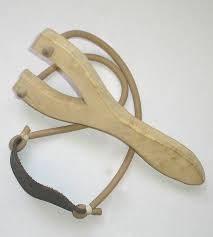
slingshot (n)
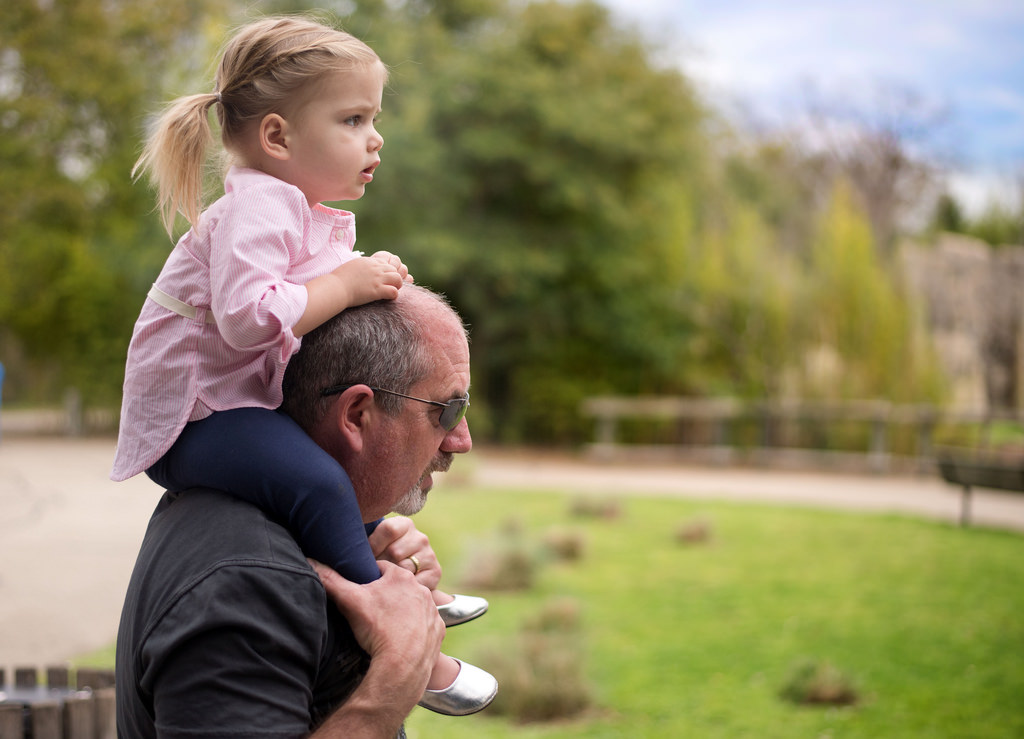
shoulder ride (n)

tiptoe (n)
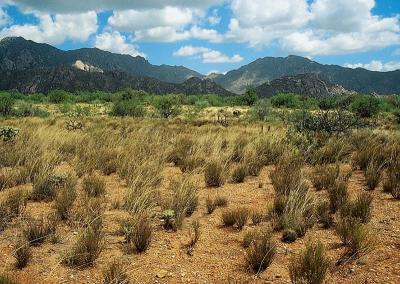
scrub (n)
convert (v) – change the form, character, or function of something
He desperately wanted to marry her, so he converted to Judaism.
She’d not yet figured out how to convert their measures of distance to miles.
knock down (v) – strike to the ground, esp. with a sharp blow / take apart
The apartment building was in such a bad condition that it was knocked down.
can’t help sth/doing sth (exp.) – someone is unable to change their behaviour or feelings, or to prevent themselves from doing something
I can’t help looking at the cake! It’s so tempting.
vacant (adj) – empty, not occupied
The position was left vacant after the chief secretary resigned.
lot (n) – a bit of land assigned for sale or for a particular use
The parking lot is completely full. We’ll have to park somewhere else.
scrub (n) – vegetation consisting mainly of brushwood
These stretches of land are often covered with scrub, while mimosa trees are found in the river valleys.
scatter (v) – throw in various random directions
When they heard the scream, they scattered in all directions.
abandon (v) – stop to look after (someone or something); leave for good, desert
People who abandon their dogs are really mean.
shoulder ride (n) – carrying someone in a special way: the person carries sits on the shoulders, by the back of the neck of the other person.
Daddy, daddy, I want a shoulder ride, too!
dead-end (n) – an end of a road or passage from which no exit is possible.
Don’t go this way. It’s a dead end and you’ll have to reverse.
meticulously (adv) – in a way that shows great attention to detail; very thoroughly
Leanne planned every detail of the event meticulously, so as to avoid a fiasco like that of her sister’s wedding.
hover (v) – remain in one place in the air, as helicopters can do. ‘Hovering parents’ are parents who always watch their children and tend to worry too much
If you hover over the word with the mouse, you’ll see its explanation.
Bees were hovering over the jam pot.
sentinel (n) – a soldier or guard whose job is to stand and keep watch
The king was afraid: there were sentinels on the bridges, on rooftops and on every corner.
prying (adj) – offensively curious or inquisitive
She didn’t want to share any more with her, left the room and closed the door against prying ears.
nothing missed sb’s prying eyes (exp) – watch over a happening or someone inquisitively and know all the details
eager (adj) – strongly wanting to do or have something
I’m eager to learn, Master!
there is a fair chance (exp) – it is very possible
There’s a fair chance that they’ll fall in love. Just look at the way they are dancing!
scenario (n) – a written outline of a film, novel, or stage work giving details of the plot and individual scenes / in the abstract sense: a sequence or development of events
I’m afraid this is the worst case scenario of the climate crisis.
plausible (adj) – (of an argument or statement) seeming reasonable or probable
Give me a plausible scenario.
The most plausible hypothesis is that of Mr Einstein’s.
trim (v) – make (something) neat or of the required size or form by cutting away irregular or unwanted parts
I don’t like it if the hedge is trimmed too neatly. Leave it a little wild.
regimented (adj) – very strictly organized or controlled
Diets are regimented and don’t take into consideration that variety is the spice of life.
giggly (adj) – (of a laughter) childlike: amused, excited, or silly. A giggle is a light and repeated laugh
She can get very giggly after the second glass of wine.
play tag (v) – play a classic kids’ game: one person chases the rest, and anyone who is caught then becomes the pursuer
You wanna play tag? You’re it! Catch me if you can!
make use of sth (exp) – use sth for a purpose
If I were you, I’d make use of all the resources here.
tiptoe (v, n) – walk carefully, with one’s heels off the ground
I didn’t want to wake my parents, so I tiptoed around them.
fingertip – the ends (tips) of the fingers
All you need is right at your fingertips at your magnificent shopping mall.
triumphantly (adv) – in a way that shows great happiness or joy over a victory or achievement
The toddler opened the bottle, then looked at me triumphantly. He’d never done that before.
shriek (n) – a high-pitched scream
Crows were shrieking in the park.
mush (n) – a soft, wet, pulpy mass
He felt the mush of soft wet sand beneath his feet.
ooze (v) – (of a fluid) slowly trickle or seep out of something. Somewhere between dripping and flowing
The night was stabbed, blood was oozing from his chest.
gratitude (n) – the quality of being thankful; readiness to show appreciation for something and to return kindness
We would like to express our deep gratitude for your generous support.
nuisance (n) – a person or thing causing inconvenience or annoyance
My brother keeps calling me names, stealing my toys and he’s loud. He’s a real nuisance!
Bureucracy is such a nuisance.
menace (n) – a person or thing that is likely to cause harm. Can be used for a very naughty kid (e.g.: the cartoon, Denis the Menace)
Dennis the Menace is a famous cartoon. The blonde little kid does all sort of mischief.
slingshot (n) – a handheld catapult
Dennis the Menace often uses his slingshot to annoy the neighbours. Windows often break.
knock it off (exp) – stop it
I’ve had enough of this! Knock it off!
bug (v), (informal) – annoy or bother (someone)
People who talk too much bug me.
pick on (v) – criticise or treat someone unkindly in an unfair way
Why are you always picking on me? I did nothing wrong to you, really!
take sth for granted (exp) – never think about something because you believe it will always be available or stay exactly the same
Matt, don’t take me for granted. I’m not the kind of woman who stays no matter what.
smear (v) – spread (a greasy or sticky substance) over something
When going to battle, these tribesmen smear themselves with ochres, mud and even blood.
Now start the vocab quiz






Grammar
The many meanings of “would”
When it comes to “would”, there are usually two uses that pop into our mind: conditional and polite requests. We are not going to cover these common uses of “would” here, we are going to focus on their special uses.
Let us just give you some example sentences of the two common uses.
Conditional
If you knew her, you wouldn’t ask that question from her.
We can use the conditional without the condition in the if-clause:
We would know. The dogs would bark and we‘d know.
(We would know if someone came here. If someone came here, the dogs would bark.)
Polite requests
Would you trim my son’s hair, please?
Would you mind palying tag with my kids?
Would you clear up this mush, please?
Now let’s look at the uses that we ARE going to cover thoroughly.
Past habits and characteristics
To talk about past habits and characteristics you probably use ‘used to’ regularly. However, it is possible, and actually quite frequent to apply ‘would’ in these cases. However, you must keep one thing in mind: While ‘used to’ can express actions and states as well, ‘would’ can be applied only for actions. Compare:
It was almost as vacant as it used to be, only that a concrete pathway now ran through it. (‘be’ is a state verb, it can take only ‘used to’)
So she would carry him on her shoulders to kindergarten every day, there and back, leaning against the thick white layer of soft cold. (‘carry’ is an action verb, it can take both ‘used to’ and ‘would’)
Some more examples where you can use ‘would’ in this meaning:
They would spend whole afternoons up in that cherry tree, talking, reading, teasing, spying on the neighbours and the passers-by.
He would get there and tell Mike to pick at someone of his size.
He would shoot pebbles at them out of his slingshot. He would steal their things, swear at them, grab Nicki and pull her hair.
Willingness
WILLINGNESS IN THE PAST
If you want to express how happy/inclined someone was to do something (very often as a response to a request), you can use ‘would’.
There are two kinds of willingness you can express like this: habitual and specific (a one-time thing).
Habitual willingness/inclination is very similar to past habits (discussed above) – they are both a result of either character or external circumstances. Therefore, these categories often overlap. Sometimes, the context makes it clear which case we are facing and sometimes sentences can be interpreted as an example of both categories. The aim here is to see the different shades and hues of meaning and not to learn some strict grammar formula.
‘would‘ (=the positive form) can only be used if someone was happy/inclined to do something habitually.
The reason why I adored that teacher is that he would help me whenever I turned to him.
Look at the following examples from the story. We know that these things happened often and the protagonist’s willingness to help was habitual, Nicki knew that he would always help her.
‘Tell him to knock it off!’ and he’d run to face the menace.
‘He’s being mean, do something,’ and he’d push Mike away.
‘Mike won’t stop bugging me!’ and he would go there and face Mike.
‘Wouldn’t‘, on the other hand, can express both habitual and specific willingness:
He was a nuisance and a menace, he wouldn’t stop harassing the other kids. (habitual)
He was so mean, he wouldn’t talk to me by any means. (habitual)
He was so angry with me that he wouldn’t talk to me for days. (specific)
I tried to turn the key many times but the door wouldn’t open. (specific)
WILLINGNESS IN THE PRESENT AND THE FUTURE
The modal ‘would’ can also express present (or rather future) willingness when we hypothesize that someone else (other than the speaker) would or wouldn’t be willing to do something.
The teacher’s brother is a lawyer, he surely wouldn’t do such a thing, nor would Annie, she’s only twelve.
The following example of willingness can also be interpreted as conditional without the condition in the if-clause.
Do you need money? I think Henry wouldn’t lend you any, but George would.
(Henry wouldn’t lend you any, but George would if you asked.)
If we talk about ourselves, we use ‘will’ to express willingness:
Do you need money? I‘ll lend you some.
(This means “I’m willing to lend you some.” If we said it with ‘would’, it would imply that I want to set a condition, and only if you fulfil that condition will you get the money. (Do you need money? I would lend you some if you did me a favour…))
Future in the past
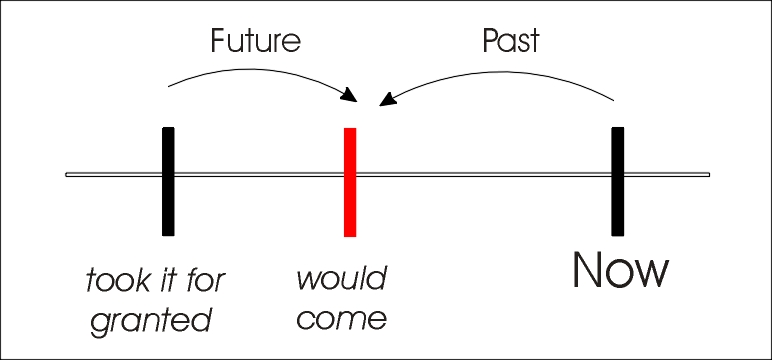
Let’s imagine a situation in the present:
Nicki takes it for granted that he will come to her aid.
Now let’s imagine that this whole situation is over – it’s in the past.
Nicki took it for granted that he would come to her aid.
Both activities (‘took it for granted’ and ‘would come’) happened in the past, before now. However, ‘would come’ was only a future perspective at the time of ‘taking it granted’.
Take a look at the graphic explanation below:
Similarly, if the original sentence contains Future Continuous, the future in the past form will keep the continuous aspect. The same applies to perfect forms.
We were absolutely positive that my parents would be visiting in the afternoon.
I had no doubt that they would have had dinner by the end of the film.
Now check your grammar knowledge.
Watch, listen and repeat
In this video you can practice the pronunciation of some sentences from the short story, especially the ones with would. Listen and repeat after the speaker.
From here you can download the audio of the video above. Use it for practicing while driving, waiting, tidying, etc.:
Do you have any questions about the lesson? Feel free to ask. We are here to answer.
Do you have any questions about this lesson? Feel free to ask us here, we will reply. (And don't worry about making mistakes)
0 Comments